 Longform · May 21, 2026
Imagination is still a superpower
LLMs keep telling creative workers that judgment and taste are what remain. That answer is right but too abstract. The sharper answer is imagination: the ability to hold an image before the machine can retrieve it.
 029
029 15 min
There’s not a single person working today that won’t be asking what is their role after the unstoppable unravel of Artificial Intelligence. Lately, LLMs have given us an answer: judgement and taste. That’s a fairly abstract answer, and yet, it’s the best we got. So I’d like to dissect these concepts and, hopefully, get to a more tangible answer.
I’m focusing more on design work, but most of it apply to other intellectual work. Concept developers, product managers, innovators.
You may also find it refreshing that I actually wrote this, so there’s not a lot of the quirks of AI writing. LLMs helped me to find related academic references, some chapter structuring (that I reviewed later) and some blind spots in the argumentation (just let me keep my em dashes; I’ve used them for decades).
My argument has four parts.
First, let’s grieve and find meaning.
Second, let’s name the difference between style, taste, vanguard, and imagination, because those words are often used as if they were interchangeable.
Third, once we know what imagination is for, we can understand why it matters that synthetic imagination drifts from culture's first-order material, and why human work still depends on capturing wild data.
And fourth, we can return to the tools themselves: why current AI interfaces are not yet optimal for design work, and why they demand a sharper internal image from the person using them.

I. “It’s just a bubble, and everything is OK”
It’s definitely not. Not a bubble, not OK. I have seen a lot of designers fiercely resisting AI. The reasons are multiple: a clumsy push from non-design managers, a feeling of skill erosion, or the plain dissatisfaction with the current toolkit. All those are valid, but not valid enough to dismiss AI.
Designers are often the dissonant resistors in this, and that could be good. But the dissonance is rarely well modulated. It’s not a smart move to make things a “moral imperative”. The discussion about “is AI art?” does not belong to the workroom, as much as the question “is commercial design art?” also doesn’t. Unless altogether reckless, companies have specialized teams working with guardrails, safety, ethics. If the designer’s first point in the room is “but is it used ethically?”, it’s a way of deflecting the possibilities, and creating an anchor, in a discussion that already exists in specific development departments. And I believe this anchor, misplaced, is part of the perception of AI as a threat, so it’s activated by fear, not interest.
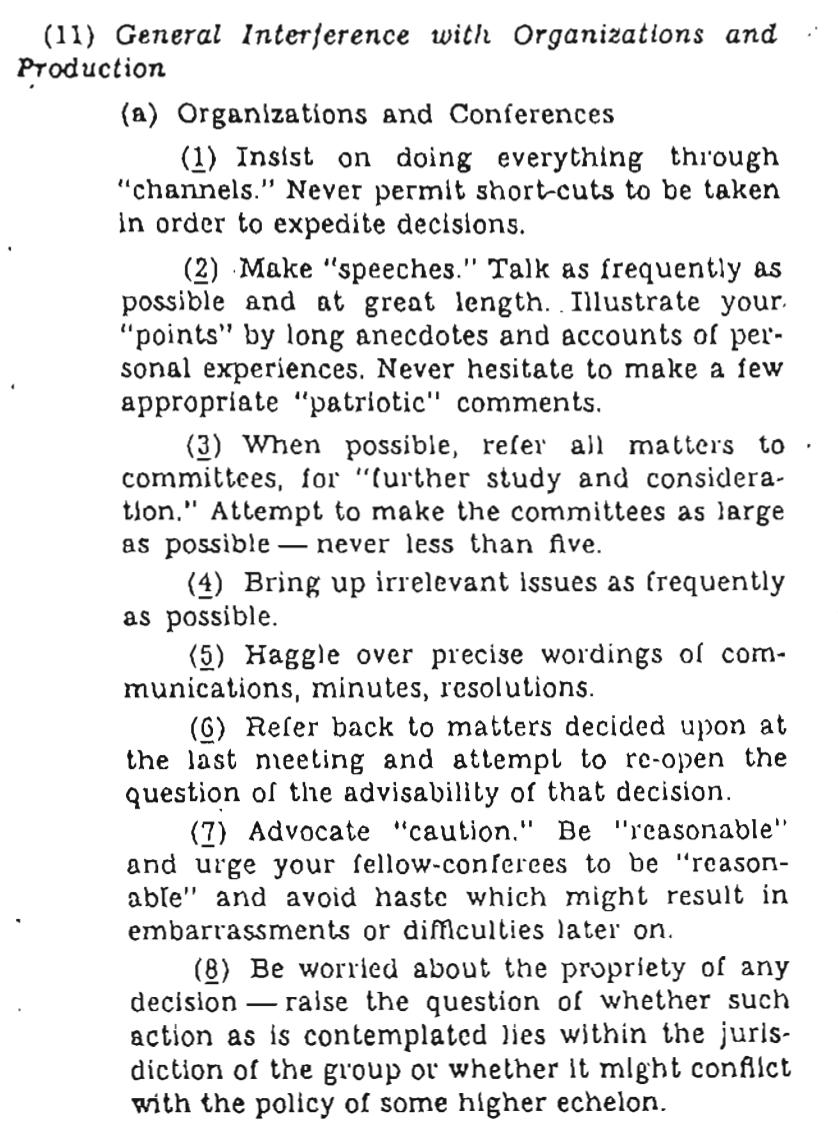
The declassified CIA Manual of Simple Sabotage.
The point is not to avoid the important conversations, but rather not make that your chief argument. The chief argument of a designer should be “can this help me to produce better work?”, and then the other topics fall into place. My point is not to passively accept AI, but not to fall into the trap of making your own narrative about your skill one of resistance, but rather one of adaptive behavior.
The designer’s grief cycle around AI has a specific texture. David Kessler, who added a sixth stage to Elisabeth Kübler-Ross's original five in Finding Meaning (2019), described bargaining as the phase where resistance starts looking like adaptation.
The designer who once said "AI can't replace real creative work" now says "I'm now an AI-augmented designer." The consultant who protected their proprietary frameworks now publishes them as prompts. The strategist who built their reputation on synthesis now calls themselves a "sense-making layer." The change is real. Genuine tools are being adopted, genuine workflows are being rebuilt.
What’s left?
So what is left for us, humans? We don’t know all the answers yet, but so far, it has to do with “judgement and taste”. LLMs has been pushing this answer like crazy, but we don’t know what it means exactly. I will try to uncover a bit of what “taste” is later on, but “judgement” is, interestingly, the agency we have for decision-making.
So far, it’s fair to say, AI doesn’t have access to a lot of data that inform us about a decision. “This is never going to fly when we show it to Jorma” is a good data point that leads a designer to choose AI’s version A instead of proposed version B.
I made a post about what changed in 60 years of design. Deciding how to take a task forward, and deciding what is going to be implemented is not something that has ever been automated. So we may trust, for now, that this is part of our duties. But that doesn’t mean things didn’t change. The designer role is being pushed upwards. UX designers can much more comfortably act as product designers, because AI augments a lot of knowledge about product, market and technology in the workflow. So we get back to the question of meaning: how can I make something meaningful for me with all the changes happening? That’s a very personal question, so I won’t answer it. Meaning can be “I can finally make more decisions”, or “I finally have the answers to strategic questions I didn’t have before”, or simply “AI helps to be do my best work”. That’s turning denial, anger, bargaining into meaning.
Busywork and meaning
A significant portion of what designers have historically been paid to do is infrastructural: confirming the accessible navigation tree is sound, the error states handled, the responsive breakpoints consistent, the checkout flow has a return path, the form validation meets expected patterns, the loading and empty states accounted for. This work is not trivial — it requires real knowledge and carries real consequences when it fails — but it is, structurally, a question of whether a given output meets established standards. That is a pattern-matching problem, and large language models are exceptionally good at pattern-matching against documented standards.
When a designer prompts an AI agent to build an e-commerce site for a mug brand, the machine produces something with inventory logic, a return flow, accessibility attributes, and responsive breakpoints. It produces things the designer had not yet articulated as requirements, because those requirements are well-represented in the training data, drawn from thousands of similar implementations. The AI is not being creative; it is retrieving a statistical consensus of what a functioning e-commerce site requires. But the retrieval is genuinely useful, in the same way a thorough checklist is useful: it closes the gap between what you thought to specify and what the problem actually demands. The designer who once spent the first third of a project building and verifying this infrastructure now receives it as a starting condition. That is a transfer, not an augmentation. Work that existed is gone; capacity that was consumed is available.
The denial version of this story sounds reasonable from the inside: AI can assist with the basics, but the real design judgment is still mine. You add an AI layer to your existing process, produce the same deliverables faster and cheaper, and describe it as transformation without seriously examining what has actually transferred. The tell, looking back, is that the core of what you do never gets examined. The question worth asking — what was the coverage work costing in terms of the attention it consumed — tends not to get asked, because its answer leads somewhere unsettling.
Most designers, honest with themselves, will recognise that a significant portion of their cognitive load on any given project was allocated to precisely the work the machine now handles adequately. The research sweep that confirmed what you already suspected. The accessibility audit that flagged the seven issues you knew were there. The pattern library search that found the component you were going to find anyway. None of this was wasted time — it was the work, and doing it built the competence that made you trustworthy. But the attention it consumed was not, in retrospect, being spent on the thing that makes a design project worth doing. That attention is now available. The question is whether it gets redirected toward the work the machine cannot yet do, or quietly absorbed into a faster version of the same process.
What that redirection looks like depends on a distinction — between work that has a correct answer and work that does not — that the rest of this essay tries to draw precisely enough to be useful.
II. What’s with “taste” all of a sudden?
Ask any of the major AI systems for guidance on design quality and you receive a version of the same answer: develop your taste, exercise your judgment, cultivate a point of view. The advice is not wrong. But the AI systems are not themselves performing what they recommend, and the gap between the advice and the performance reveals a distinction that matters practically.
"Taste,", “Style”, "vanguard," and "imagination" tend to be used as if they were the same thing or points on a single scale. They are three different operations with very different relationships to what AI can and cannot do. Interestingly, they relate to different movements in culture that now, more than ever, matter to understand.
So in order to make a proper vocabulary:
- Vanguard breaks the grammar before culture absorbs it, and, by definition, before AI can synthesize it. Often, vanguard is what attracts attention by novelty, and becomes a marker of taste, only to be emptied by the mass adoption and reproduction of its elements.
- A Style is the consolidation of elements into a grammar; absorbed from a Vanguard recently inserted into culture and consolidated as a grammar.
- Taste is a deliberate act of selection, based on an existing grammar of style; a selection judged by its appropriateness (discrepancy, exaggeration or appropriate fit).
- Imagination holds the next image before it exists externally, absorbed from vanguard, styles, taste, and culture in general.
Style is a grammar
A style is a consolidated grammar of elements that work together to create effects, meaning and responses.
What AI systems can do, with increasing sophistication, is operate within established grammars. A well-prompted model can maintain the internal coherence of Swiss Modernism, reproduce the grid structures of Dutch editorial design, apply the visual conventions of contemporary fintech, or produce packaging that meets the expectations of the artisanal food market.
Taste is an act of selection
Taste, in the technical sense Umberto Eco develops across Opera Aperta (1962) and Apocalittici e Integrati (1964), is not a personal quirk or intuitive preference. It is a trained capacity to identify coherence, discrepancy, and exaggeration within an established aesthetic grammar. But I think it’s helpful to treat taste as an act. That simplifies things and attributes agency: taste is judgement.
To talk about taste, let’s talk about bad taste. Eco focuses on kitsch and high culture turns entirely on this distinction. Kitsch, often seen as bad taste, is not exactly a style; it is an operation: the prefabrication of effect, the deployment of borrowed formal moves to produce a predictable emotional response without the interpretive effort the original demanded.
So taste for a designer is about selecting which grammar to apply, and is itself a probabilistic calculation: given the brief, the audience, the competitive context, which conventions carry the highest likelihood of being received as appropriate?
Recommendation systems have been performing the adjacent version of this for years, not by generating taste but by reinforcing it. They surface content and creators whose vocabulary is likely to influence the people who encounter them, tightening the feedback loops through which individual preferences become shared conventions, which then become market expectations, which then become the constraints within which the next generation operates. Algorithmic reinforcement does not produce new aesthetic positions. It accelerates the consolidation of existing ones.
Vanguard is novelty, still in formation
Vanguard is a different operation, and the difference is not one of degree but of kind. The avant-garde gesture, as Eco understood it and as Doshi and Hauser (2024) document empirically in the context of AI-driven creative homogenisation, does not draw from the established repertoire. It disrupts the grammar, takes a position outside it, uses that position to make the grammar visible as a grammar rather than as nature. Its source material is the still-live dataset: visual work circulating in culture before it has been named, categorised, absorbed, or documented at scale — street aesthetics, subcultural visual languages, formal experiments still being made in marginal publication before they have travelled from avant-garde practice to design blog to corporate application.
By the time a visual style is well-represented in a training corpus, it is already in the absorption phase. With AI Slop, the exhaustion of this style is already imminent. The model operates, by structural necessity, on what culture has already half-processed. It can accelerate the distribution of a style that has been named; it cannot be at the frontier of a style that has not yet been legible enough to document. And it cannot predict (so far) which next styles will capture the hearts of people and become the next big thing.
Walter Benjamin's argument in The Work of Art in the Age of Mechanical Reproduction (1935) applies directly, with a sharper edge: when a visual grammar becomes reproducible, it is, by that very fact, no longer at the frontier. Reproduction is the mechanism of legibility, and legibility is the end of the avant-garde function for that gesture.
What it means for creative workers
So you can already see where I am going with this. You take, for example, a new style that Pixar, or Ghibli, or Guillermo Del Toro, or Bad Bunny, or Käärijä have created (out of their lived experience or artistic sensibility), and throw it into culture. It’s new, fresh, interesting, weird. Importantly, it comes from living creatures who strive, hurt, fear and celebrate their own condition. People follow these luminaries not only the work they produce resonates with them (a calibrated AI could do that), but because there is a certain aspiration, and human-level connection.
The mechanism is the same since the XX Century: vanguard offers something new, mass media appropriates and devoids it of meaning. It’s just a lot faster and widespread now with “AI slop”.
AI adds a lot of speed to this dynamic. A visual language that once required years to travel from an avant-garde publication to a mainstream corporate application — the Bauhaus grid entering corporate branding, punk typography entering magazine design, brutalist web aesthetics entering fintech landing pages — can now make that journey in months. The absorption phase compresses; the exhaustion phase arrives faster; the demand for the next genuine gesture intensifies sooner. Doshi and Hauser document exactly this. When the machinery of absorption operates at scale and speed, the scarcity value of the original gesture — the thing that was genuinely new before the cycle began — increases. The machine is doing the derivative work faster. It is still derivative work. Someone still has to produce the thing it will become derivative of.
This is what AI is pointing at when it advises developing taste. The advice indicates the right territory (the territory where AI cannot operate), but uses the wrong word. It’s not about good and bad taste, because AI can select a reasonably appropriate palette of styles and apply it to a layout.
What cannot be reproduced is not taste in the sense of style management, which is largely already automated. What cannot be reproduced is the vanguard capacity, and behind that, the imaginative capacity that allows the vanguard gesture to be held in the mind before it is made. Vanguard is imagination when you are the one bringing it, rather than selecting from what culture has already made legible.
III. Imagination and Wild Data
Imagination, in AI-native design work, is not a creative virtue or a personality trait. It is the capacity to hold a precise internal image of an intended outcome before the world, or the model, has produced it.
The etymology is worth holding: imago, Latin for image, for likeness, for the representation of a thing in the mind. In Roman usage the word referred specifically to the wax portrait masks kept by aristocratic families to represent their ancestors in funeral processions — an image held in place of a presence, a substitute for a body no longer available for direct experience. The implication is precise: imagination is not free-ranging vision but the specific capacity to hold something concrete in the mind in the absence of the external referent. Different from creativity in the general sense, from curiosity, from aesthetic sensitivity. It is the ability to see, with enough precision to act on, something that does not yet exist in the world.
That matters because imagination needs material. And here the argument rests on an important premise that should now be made explicit. Generative systems do not encounter the world directly. They encounter representations that have already passed social filtering, amplification, documentation, circulation, and absorption and, importantly, commercial algorithmic amplification. The result is not imagination in the human sense but a recursive cultural recombination. We also do, strictu sensu, a cultural recombination in our imagination process. But the LLM is behind us on this; we feed the machine, not the other way around (even when our production in culture is affected by it).
This creates drift. Not because the machine becomes detached from culture, but because it becomes increasingly saturated with culture after consolidation, and culture has already departed to the next vanguard.
Each generation absorbs the previous consensus and produces work shaped by that consensus, which becomes input for the next absorption cycle.
The frontier, or vanguard — the place where new symbolic material is actually being made — is outside this loop entirely. It is in subcultural aesthetics, emerging emotional grammars, marginal visual experiments, unstable symbolic forms, and lived contradictions still circulating below visibility thresholds. Wild data.
Social algorithms already industrialised a version of this process, and the distinction is crucial. They amplify emerging signals. They do not surface truly unknown ones. They reward acceleration of legibility, not the illegible frontier itself. A signal becomes algorithmically visible at the exact moment it has begun to be readable to enough people that engagement metrics rise — which is to say, at the moment its raw frontier value has already started to decline. The platforms that look like vanguard detection systems are in fact absorption accelerators. They compress the distance between emergence and consensus, narrowing the window in which a gesture can remain genuinely new.
The Vanguard, as a result, keeps narrowing. The machine absorbs faster while culture produces genuinely new symbolic material more slowly — partly because the conditions for slow, illegible, first-order experience are themselves being eroded by the same systems doing the absorbing. The compression produces an aesthetic exhaustion that designers can already feel in the corpus: the sameness across AI-generated brand identities, the recognisable signature of synthetic illustration, the way that a sufficiently AI-saturated visual environment starts to refer only to itself.
Artists matter here not as mystical figures but as something more structural. They remain, when they remain, attached to first-order experience before it becomes representational consensus. They observe what is happening in a body, in a neighbourhood, in a generation, in a material, before that observation has acquired its eventual symbolic form.
Artists can experience mortality, shame, erotic tension, class aspiration, ageing, illness, humiliation, grief, heat, exhaustion, or desire directly. These are the inputs the model cannot generate from its existing corpus. They are not romantic figures of authenticity. They are the first-order input layer of future machine imagination, and that is what people seek when seeking inspiration. Can AI create a text that is so incredible that will touch the hearts of everyone? Yes. But these may coexist with a constellation of artists, luminaires and personalities that inspire us because they are human.
IV. The microphysics of design work
Once we understand what imagination is for, the tool problem becomes easier to see. The interface through which a designer interacts with an AI agent is not neutral. It shapes which decisions can be made in which order, and therefore which capabilities remain valuable.
The classical AI workflow — Claude Code, Cursor, the terminal-adjacent agents that defined the first phase of AI-assisted design — operates on a command-line model.
- The designer writes a prompt
- The machine processes
- The output reloads
- Tokens burn.
Crucially, the designer must commit to a direction before seeing its result. The visual judgment that in a graphical tool happens mid-gesture (dragging an icon across a composition, reading the imbalance before the hand makes its final move, adjusting without ever fully stopping) here has to happen entirely inside the designer's head before the first word of the prompt is written.
The shift is not minor. It is a change in where cognition is allowed to live.
What graphical tools allowed
- navigate before fully knowing
- discover through manipulation
- distribute cognition across hand, eye, and screen
What command-based AI requires
- specify before seeing
- hold the image internally first
- commit direction before feedback arrives
So the superpower of a designer here is having a very vivid, sharp envisioning of what it will look like. In other words, it’s an exercise of imagination. But this is taxing imagination from a big, free-flight process into a restricted, timed and monetized box in which the designer imagines what will be the next prompt, and then the next, and then the next. This has been proven to be costly, slow, and frustrating.
Figma's design agent, launched in May 2026, is best understood as an explicit attempt to address this mismatch. The announcement framed the problem directly: speed or precision, AI generation or direct manipulation, so you shouldn't have to choose. The agent works on the multiplayer canvas, aware of components, variables, and the standards a team has built over time. Designers and agents work in parallel on the same surface. A designer at Notion described doing "almost all of my design ideation on the canvas" and then having the agent "take it the last mile." But many designers may work the other way around, letting AI do the bulk and fine-tuning with mouse and click. Would Figma solve that, too?
The advance is real. It should not be granted more conceptual dignity than it deserves. What Figma's agent reduces is friction inside execution. It does not solve the epistemological problem of direction. The designer still commits before the output exists. The dependency on a destination in mind before the journey begins is not removed; if anything, it is deepened, because iteration becomes so cheap that motion can be mistaken for a new vision.
Faster iteration risks producing a new form of professional confusion: the belief that acceleration itself constitutes direction. Cheap iteration can conceal the absence of a coherent image.
The agent is well-suited to problems in meeting standards: apply the right component, maintain the grid, generate responsive variants, run the accessibility pass, produce ten colour-scheme iterations. These have correct answers within existing standards. A designer who spends time navigating convergent problems manually in 2026 is, in a real sense, spending time they do not have to spend.
The work that does not have a correct answer yet — what the mug brand should feel like, which visual grammar is worth drawing from, what in the current culture it should be in conversation with, and how that conversation should be made visible — is a divergent problem. The command-line and canvas-agent paradigms are useful here only to the extent that the designer already knows what they want to produce. How to know what you want is a different problem, and it is the one the rest of this essay has been circling: the imaginative capacity to hold an internal image before the tool can externalise it.
So, the takeaway: designing is not prompting, designing is not commanding and committing. The market is squeezing those into the same space, and designers will meet friction until this is resolved. If pushed towards AI without a clearer account of imagination, they may just become slower and more expensive, and not even want to go back from “vibe designing” (which honestly, doesn’t even sound like a concept anyone wants).
This requirement was always present in design work, but it was masked. The real-time feedback architecture of graphical tools was an extraordinarily efficient compensation mechanism for partial vision. Drag, observe, adjust, release. Each cycle cost fractions of a second and nothing else. The hand and the eye did the work that a less practised visual imagination could not do, and the result was indistinguishable from the result of a designer who had seen the composition clearly before beginning. The tool was, in a meaningful sense, a prosthetic for internal precision — and the prosthetic was so good that an entire generation of designers built distinguished careers without ever needing to develop the precision the tool was substituting for.
When the prosthetic is removed — when the feedback loop extends from milliseconds to seconds, when each iteration carries a cost, when commitment to direction must precede evidence for it — the part of the designer's capability that was built on real-time navigation is suddenly not available. What remains is the internal model, and the question is how complete and precise that model is. For designers who built their practice on graphical tools, the first encounter with command-line AI often feels like losing a limb: not because the capability is weaker, but because the capability that remains is exposed as a distinct thing from the capability that was compensating for it.
This applies at every level. The senior designer with twenty years of Figma experience may have built extraordinarily refined judgment through thousands of hours of real-time navigation without ever having needed to hold a complete composition in the mind before the first mark is made. Whether that capacity can be built in mid-career — whether it requires a different relationship to drawing, to mental rehearsal, to the cultural observation that precedes the design act — is a question the profession is only beginning to take seriously.
Figma's canvas-native agent restores some of the feedback loop, and for the navigation of convergent problems this is a genuine return of something like the graphical tool's real-time advantage. But the limit matters. The canvas agent accelerates the iteration phase of a process that has already begun. It does not accelerate the phase before iteration: the observation, the cultural reading, the decision about which direction is worth iterating toward. That phase requires the internal image to exist before the agent is opened. The agent cannot help you decide what you want. It can only help you get there once you know.
For designers who have, or who will build, the capacity to hold a precise internal image before the command, the AI tooling is an accelerant of a very specific kind. The base layer of a project that once consumed weeks arrives in hours. The coverage work that once required careful verification is generated and checked. The responsive variants, the accessibility pass, the component library application, the iteration set: all of this is cheaper and faster, which means the designer's time is available for the work the machine cannot retrieve from its training data. This is where the economic argument lands.
Design and value
This is where the economic argument finally lands. The machine's absorption rate is accelerating; the supply of genuinely new symbolic material is not. As the gap widens, the value of work that is actually upstream of the corpus — work made from observation that has not yet been processed into legibility — increases. Not because the work is rare in some artisanal sense, but because the structural position from which it is produced is rare and getting rarer. The designer who can occupy that position, who is willing to attend to what is not yet legible, who can hold an internal image of something the corpus does not contain, is performing a function the machine cannot perform from its training data and will not be able to perform in the next training run either, because the next training run will only contain what the cycle has already absorbed.
So the real superpower here belongs to the designer who is attuned to what is now, because that is what is ahead of the curve. This is not a simple task, because the attunement to the Zeitgeist means an attunement to values, attitudes, new ideas, critical thinking and a certain foresight on what has potential to be the next movement. It’s happening in streets, subcultures, communities and endless online communities.
There is an almost magical skill in this, and some people can nail it. They have a feeling that what they are doing “is trending”, or “will pick up”, and soon enough they are in Marimekko prints, artist feeds, and ultimately in IKEA catalogues.
This is when we live and strive even in shape-shifting territories. It’s an acceptance and meaning stage that acknowledges the changing landscape, and still doesn’t look like “conformity”, or a generic “AI-augmented workflow”. It’s more about the discovery of what we actually do, because it’s usually unspoken. We never broke down the microphysics of reasoning, or intellectual work, or style, or taste, because we never had a machine doing it. So now once we discover what belongs to us, we can accept, develop, and make it meaningful.
The designers who will matter in the next five years are not the ones with the most fluent AI workflow. They are the ones whose capacity of imagination and envisioning reaches the cultural information happening before any LLM computation. Luckily, this is about looking at what’s closest to us all.
References
Benjamin, W. (1935/2008), The Work of Art in the Age of Mechanical Reproduction, trans. J.A. Underwood, Penguin.
Central Intelligence Agency. (1944), Simple Sabotage Field Manual. Declassified public document.
Doshi, A.R. and Hauser, O.P. (2024), "Generative AI enhances individual creativity but reduces the collective diversity of novel content," Science Advances, 10(28).
Eco, U. (1962/1989), Opera Aperta / The Open Work, Harvard University Press.
Eco, U. (1964), Apocalittici e Integrati, Bompiani.
Figma. (2026), "The Figma Design Agent is Here," Figma Blog, May 20.
Kessler, D. (2019), Finding Meaning: The Sixth Stage of Grief, Scribner.
Kübler-Ross, E. (1969), On Death and Dying, Macmillan.
Everybody's SmartRewritten as the Wild Data series — shorter and sharper: