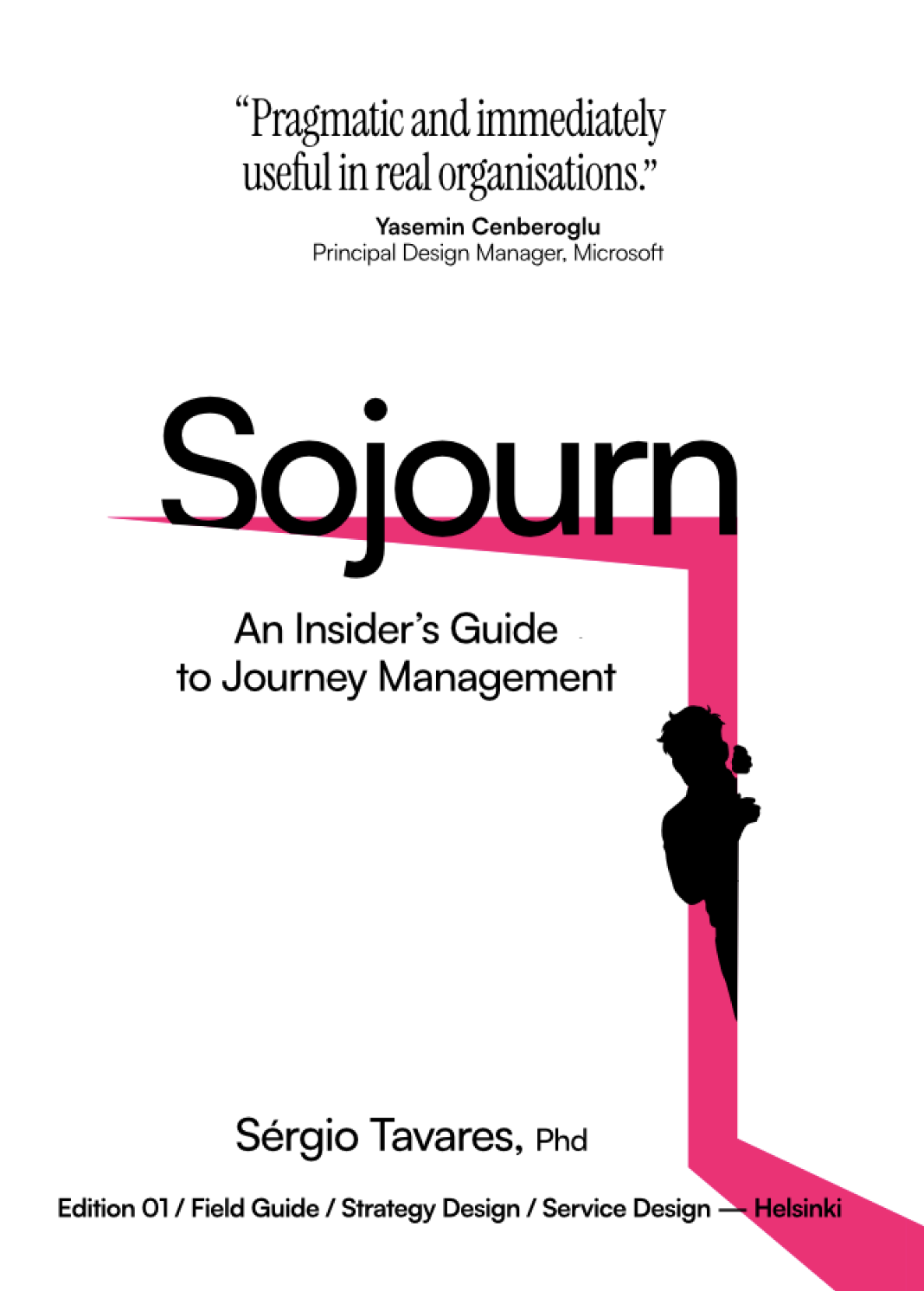
Sojourn — An Insider's Guide to Journey Management
★ Edition 01 · Limited run · 100 marked copies

Sojourn.

An Insider’s Guide to Journey Management — for practitioners, teams, and the AI agents they work with.

Author
Sérgio Tavares, PhD
Focus
Customer journey management · AI-native working
Audience
Designers · Product owners · Leaders
Edition
01 — Field Guide
Context
Helsinki · Strategy Design · Service Design
· The book
What it does · why it matters now

A methodology for turning customer journeys into the connective tissue of strategy, research, and delivery.

AI can synthesize, extract, and generate at speed. What it cannot do is decide what matters — which signals to follow, which patterns mean something, where the real tension in an experience lives. That judgment comes from methodology. Sojourn teaches the methodology.

The vocabulary in this book — insights, needs, pains, gains, moments, the fundamental map — these are the elements that structure strategic discovery whether you work with sticky notes or with an AI system. The elements don’t change. What changes is what becomes possible when you pair them with intelligence at a different speed.

· Origin story Document
Subject
Why this book exists
Author
Sérgio Tavares, PhD.
Filed
Helsinki · 2026
Format
Field Guide · Edition 01 · 100 copies
Status
In circulation
Clearance
Practitioner use · open distribution

Why this book
had to be written.

Most journey mapping practice is stuck in the consulting era — big artifacts, long timelines, outputs that impress in a room and dissolve by Monday. Sojourn is built for what happens after the workshop.

This is the origin story: where the methodology came from, what it is designed to fix, and why the AI moment made it urgent to write down before the window closed.

Ref · XXXXXXX · SJ-001 Helsinki · XXXX · 2026
Recorded · Helsinki · 2026 Sojourn_book.mp4 · Origin
· Four focal points
Getting started in a journey-driven, AI-native way of working
I
Signal & Discovery

How to collect signals without defaulting to assumptions.

How to listen for what’s said and notice what isn’t. How to source evidence from people, systems, and data — and work with AI for synthesis without losing the judgment.
II
A Cartography for your LLM

How to name the parts of an experience.

Why naming matters. What a moment is, why moments anchor the map, and how the map becomes the shared language of a team — and the structured input an AI agent can actually use.

III
The Room

How to bring stakeholders into co-creation.

How to structure a session so that evidence leads to provocation, not consensus. How to close a phase before it weakens the work downstream. How to run the room.

IV
From insights to action

How to move from a map to something a team can build.

How to identify where intervention matters most — and how to make the case for it with the people who control resources.

The vocabulary — insights, needs, pains, gains, moments — these are the elements that structure strategic discovery whether you work with sticky notes or with an AI system.
— Sojourn · An Insider’s Guide to Journey Management
· AI-native practice
Three layers · one system
01

A grammar for practitioners and their AI agents.

The book offers a vocabulary and the process — discovery, cartography, the room, the map. This is the thinking layer. It works on paper, on whiteboards, in any setting. It also works as the structured input that makes AI agents useful instead of generic.

02

Meet the companion.

Inside the book, a QR code connects you to SojournGPT — an AI companion built on the Sojourn methodology. It walks you through the process, helps you name what you’re finding, and applies the same structure the book teaches, in conversation.

→ Try SojournGPT ↗
03

Work at the speed of thinking.

The methodology now lives inside an AI-native system that collapses weeks of synthesis into a single working session. Same rigor. Same judgment calls. Discovery, synthesis, cartography, and co-creation — running in parallel instead of in sequence.

· A look inside
Selected pages · Edition 01
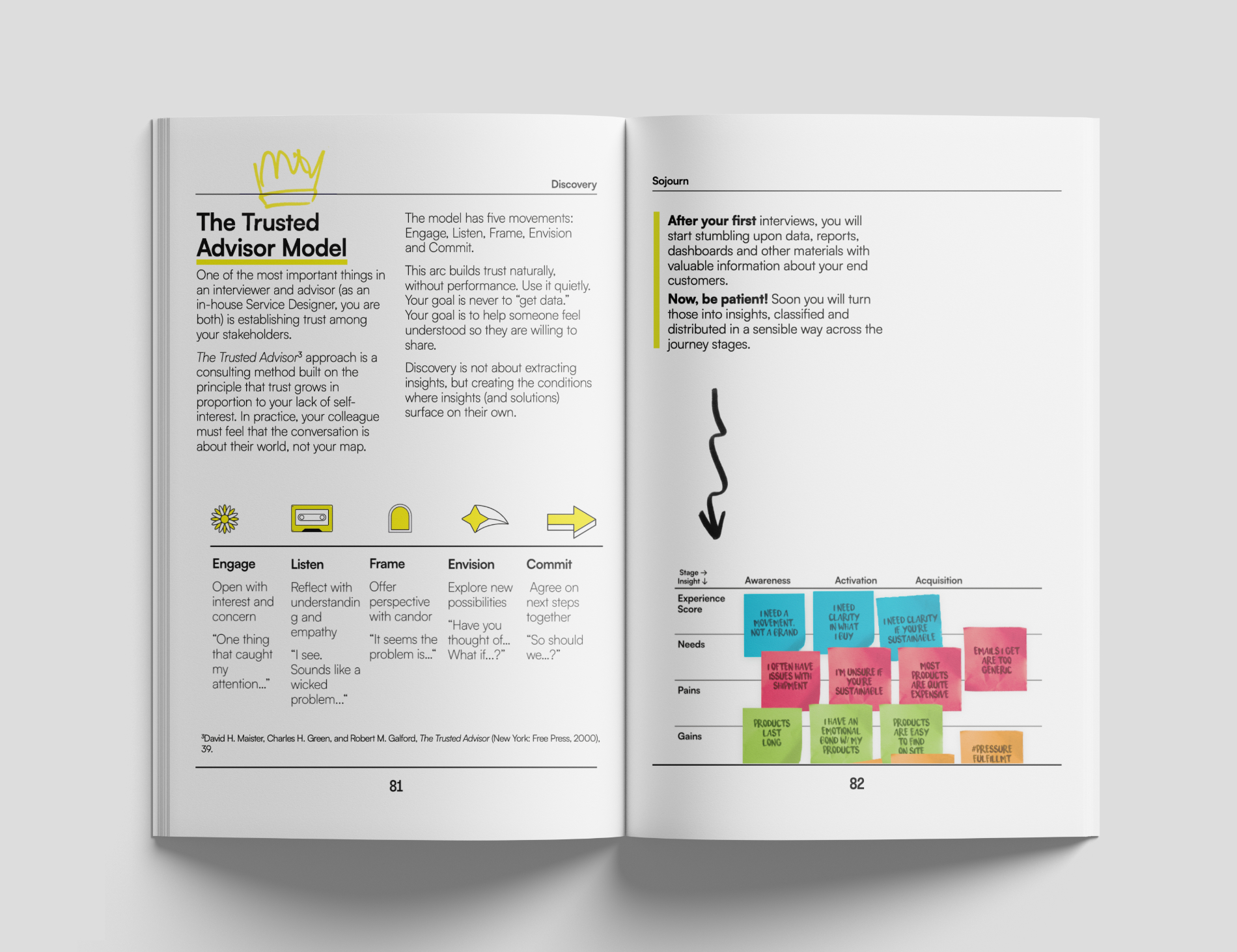
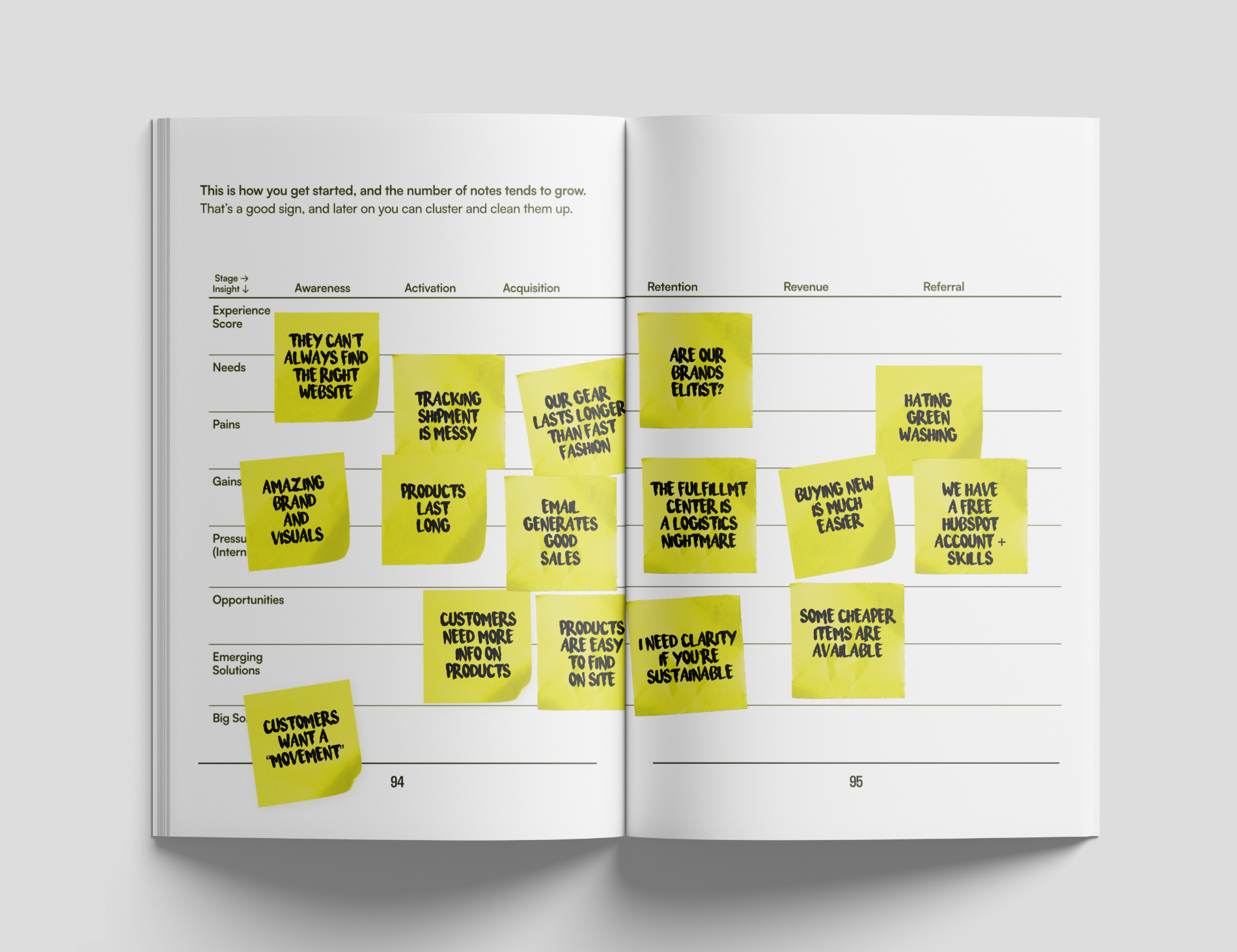
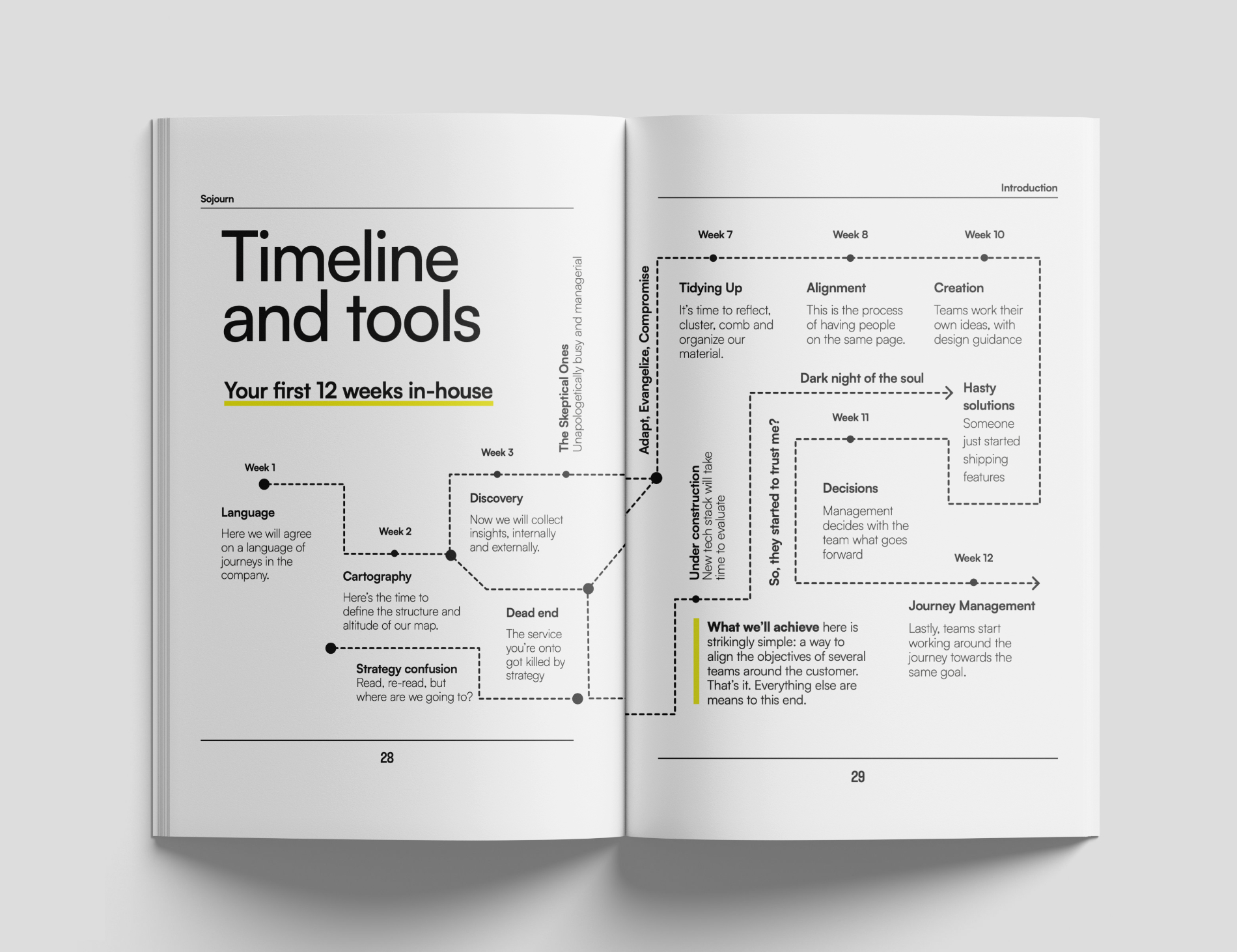
Interior spread — page 02 Interior spread — page 03 Interior spread — page 04 Interior spread — page 05
· Who it’s for
Three kinds of reader
Reader · 01

Design & Strategy teams

You run discovery workshops, map journeys, and translate evidence into concepts. This book gives you a structured methodology to replace improvised processes and a vocabulary that holds up under scrutiny.

Reader · 02

Product & Service owners

You own the experience but the evidence is scattered across departments. This book teaches you how to assemble the full picture and make the case for change with the people who control resources.

Reader · 03

Leaders managing transformation

You know something needs to change but the organization keeps optimizing what already exists. This book gives you the process to see what’s actually happening before deciding what to build.

· Early praise
Advance reader copies
01/03

Order Sojourn. Edition 01.

Limited first run. 100 individually marked copies. Field Guide / Strategy Design / Service Design — Helsinki.

· Accompanying resources
Tools · frameworks · further reading

Tools & Platforms

  • TheyDoEnterprise journey management · governance · multi-track orchestration
  • SmaplyPersonas · blueprints · journey mapping basics
  • MiroFlexible exploration before formalizing in a journey platform
  • FigJamCollaboration · journey management for Figma teams

Books worth reading alongside

  • This Is Service Design Doing — Stickdorn et al.The de facto textbook
  • Mapping Experiences — Jim KalbachMaps, alignment, cross-functional orchestration
  • The Experience-Centric Organization — Columbia Business School PressWhy CX programs fail
  • Good Services — Lou DowneService principles · public sector clarity
· Questions
Asked & answered
Who is this book for?
Practitioners. Designers and strategists who run discovery and map journeys. Product and service owners managing scattered evidence. Leaders who need to see what’s happening before deciding what to build. The book assumes familiarity with basic journey mapping — it is not an introduction, it is an operating system.
What makes it AI-native?
The vocabulary in Sojourn — insights, needs, pains, gains, moments, the map — is also the structured input that makes AI agents useful. A QR code inside the book connects to SojournGPT, a companion built on the methodology. Same process, in conversation, at AI speed.
What’s the edition format?
Edition 01 — limited first run of 100 individually marked copies. Field Guide / Strategy Design / Service Design, Helsinki. Designed as a working reference, not a one-time read.
Can I use it with my team?
Yes — the frameworks, canvases, and vocabulary are designed for team use. The book includes practical anchors: Jira-based delivery examples, cross-functional planning, and executive review cycles. Email me about bulk orders or team workshops.
Where are the downloadable canvases?
The Customer Journey Canvas, Value Proposition Canvas, Pirate Metrics sheet, Design Hypothesis Canvas, KPI Canvas, and Strategic Indicator Canvas are included with the book. Contact me if you need individual files.